
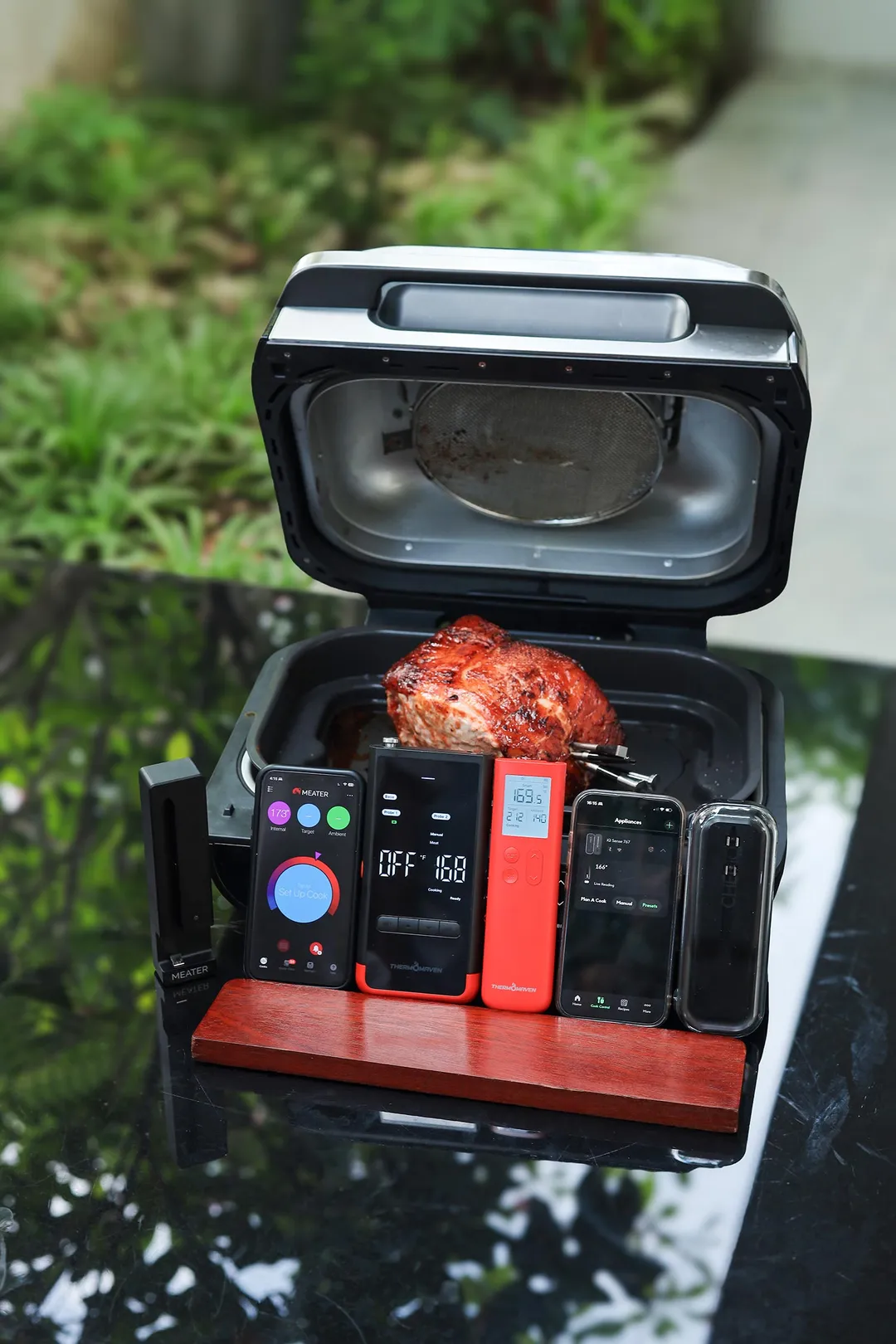
There's a particular kind of dread that hits when you slice into a chicken breast and the center is still pink. Or the opposite: you pull a beautiful ribeye off the grill, cut in, and it's cooked through to a uniform grey. Both are avoidable. Both happen when you're guessing.
A wireless meat thermometer is the fix. No need to guess or hover, just plug in the probe and walk elsewhere until your phone or the base unit (depending on the model) ping at the precise internal temperature you need the meat to be.
The market is crowded, though, and the range in quality is wider than you'd expect. I tested five of the most popular models to see which ones actually hold up – in accuracy, in range, and in the kind of day-to-day use that exposes problems a marketing page won't mention.
TLDR: The singular best wireless thermometer I’ll happily recommend, based on my testing results, is the ThermoMaven P2.
*All the prices in this article are at the point of publication.
**All test data is based on hands-on testing at ShouldIt's Lab.
Here's How I Tested Them
Temperature Accuracy
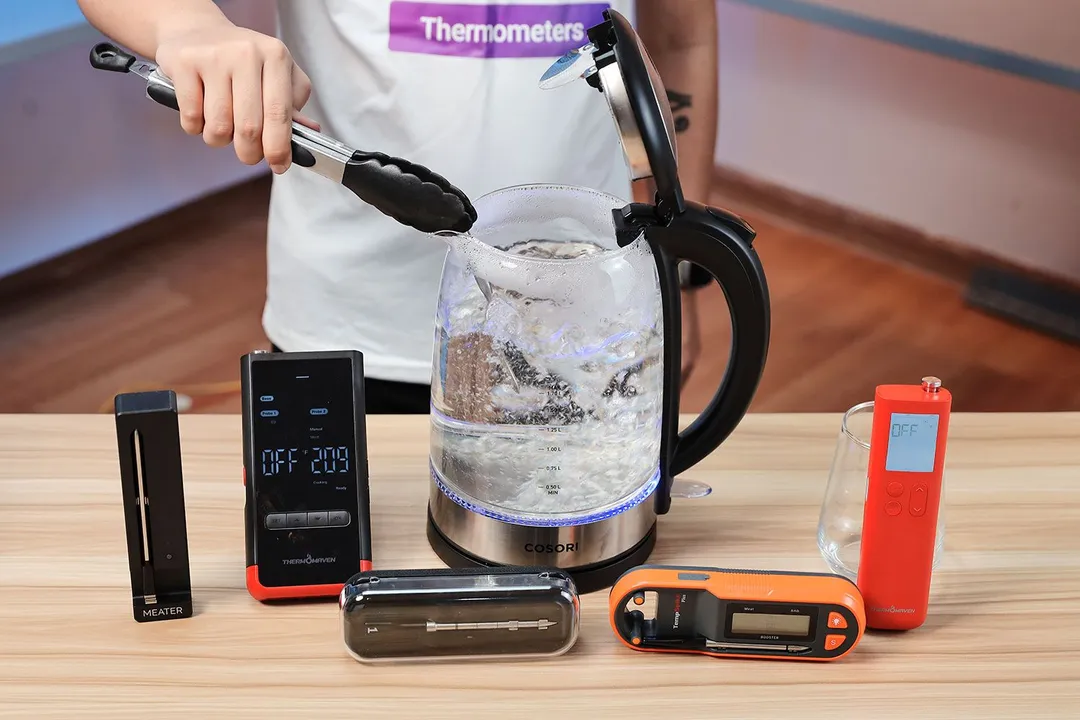
Accuracy is the foundation. A wireless thermometer that's fast and intuitive but reads 5 degrees off will sabotage your cook. I test this first because it's the one thing no design can compensate for.
I calibrate each probe against a wired thermometer, then check at two critical points: 32°F (ice water) and 212°F (boiling water). This span covers the range from cold proofing dough to medium-rare steak. The more accurate the readings, the better.
Wireless Range & Stability
A wireless thermometer that loses signal if you step into the kitchen from the backyard is barely better than wired. That’s why I also take into account how far the connection actually reaches.
I measure signal strength at four distances in real conditions: in open air and within line of sight of the probe, in my kitchen (behind a wall), and upstairs.
- Does it connect? Yes or no – non-negotiable.
- How often does it drop? I run a five-minute window and count disconnections. Even one dropout per minute is a problem when you're grilling.
- Lag time: I watch how long between a temperature shift at the probe and the update showing on the receiver or app. A 10-second lag is annoying. A 2-second lag is barely noticeable.
Note: For thermometers that have WiFi capability, we disable the WiFi to make it fairer for models without. WiFi-enabled models have virtually unlimited range so long that the probe and the receiving unit are on the same network.
Response Time
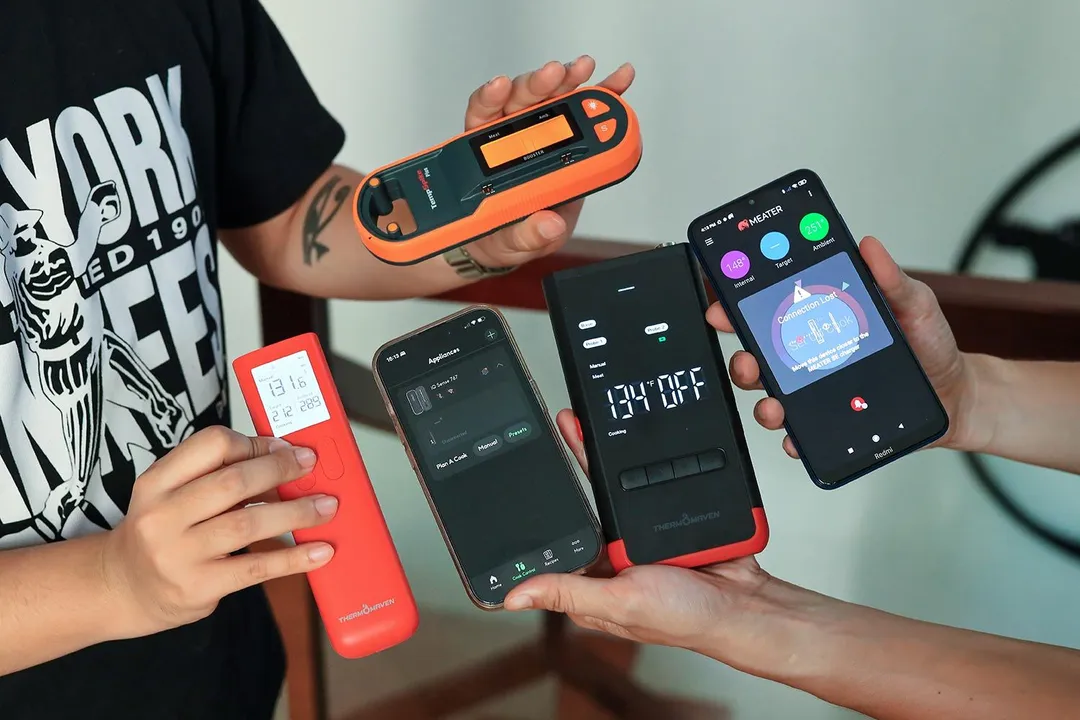
This one's simple and visceral. I take a slab of meat, stick every thermometer alongside a wired reference probe into one point, and watch how accurate the temperature reports are while we’re roasting it.
The clock starts when the grill is turned on. I time it to the second and note whether the delay creates practical problems (like overshooting your target temp because you can't see the probe catching up). The higher the responsivity, the better.
Battery Life
For extremely long cooking sessions, like smoking or slow-cooking a brisket, you need a wireless thermometer that can run for hours without dying. To test this, I ran each thermometer continuously for 12 hours – roughly what most long cooks require – to see which ones held up.
Build Quality & Usability
Taking a look at the overall build quality, fits-and-finish aside, I’ll also score how easy it is to interact and set up the thermometer (especially for those with companion smartphone apps), with special focus on the alarm function. The thermometer should notify you when the instant temperature reaches the set threshold.
How Do They Stack Up? A Side-by-Side Comparison
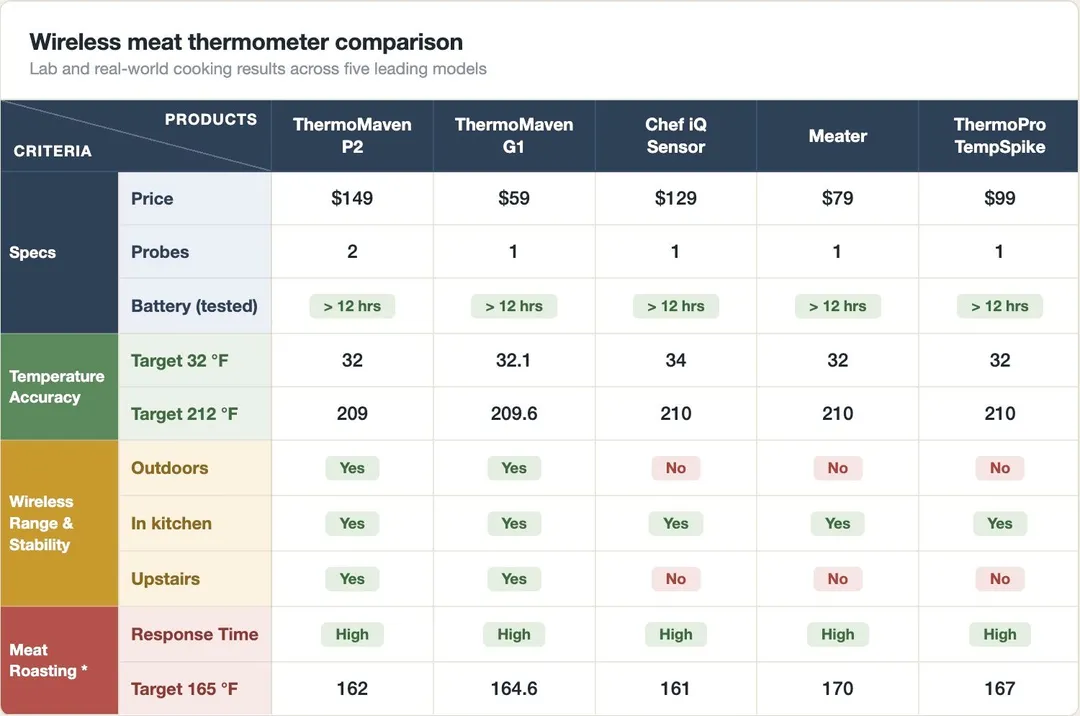
* These numbers were aggregates from two different roasts. We chose 165°F as our test target to make sure every thermometer had comfortably passed the 145°F USDA safety mark for whole-muscle cuts by the time we took our reading.
1. ThermoMaven P2 – Best to Buy ($149)
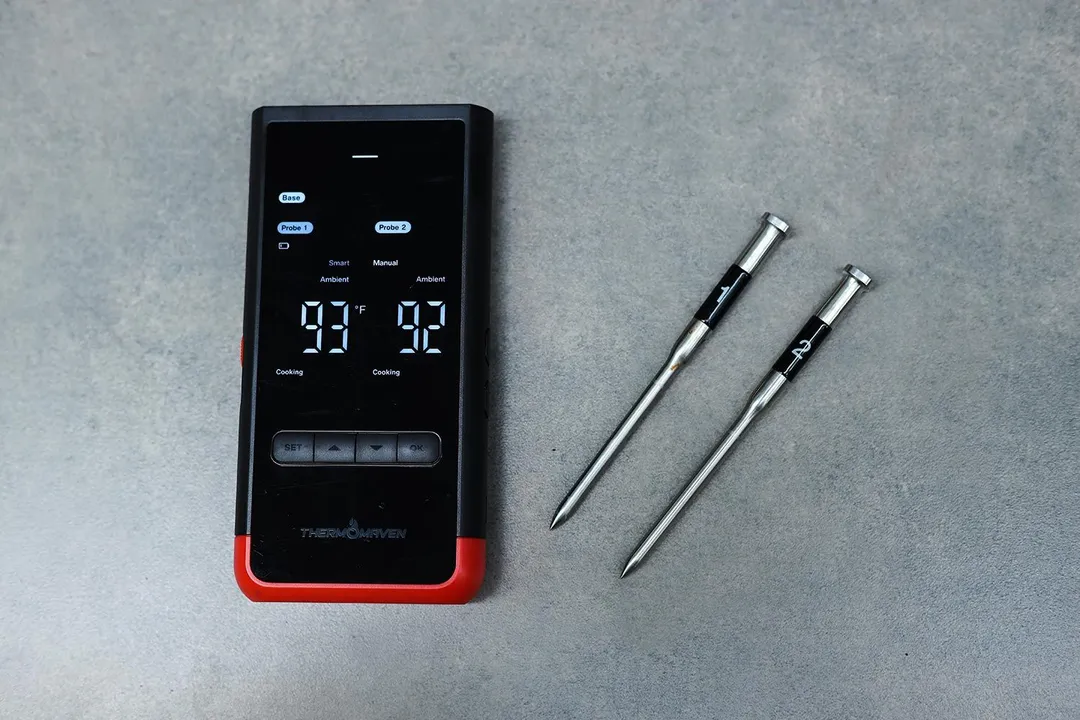
The P2 is a high-end thermometer at $149, but it wears this title well. Of the five thermometers I tested, the P2 and its sibling the G1 were the only ones that maintained a stable connection at every distance I tested – open air, one wall away, three to four walls away, and upstairs.
That last two matter more than you might think. Plenty of home cooks are running a smoker in the backyard while dinner is tracked from the couch, or from a second floor bedroom when they're doing an overnight cook. The P2 handles both without breaking a sweat.
The probe itself is 5.03 inches long and 0.19 inches in diameter – quite slim, which makes insertion into thick cuts less of a project. You get six temperature sensors total: five internal, one ambient.
Internal accuracy is rated at ±0.5°F between 32°F and 221°F, and my calibration tests backed that up cleanly: the P2 read exactly 32°F in ice water and 209°F at boiling. The pork tracking test reinforced it: the P2 landed at 162°F against a target of 165°F, still within our ±5°F window. The response time of the P2 is very sharp -- even behind several walls, we had a near real-time update of the grill’s temperature on the base unit.
Per ThermoMaven’s documentation, the ambient sensor tops out at 752°F, which covers every cooking method a home cook will realistically use.
The standalone base has a large LED display (one of the largest I've seen – it's pretty much a smartphone-sized device), a 1,950 mAh rechargeable battery, and connects via Bluetooth 5.3 up to 500 feet in open air, plus Wi-Fi for unlimited range when the base is on your network. Even after disabling the Wi-Fi and using only Bluetooth, the range is impressive.
The package comes with two probes – useful for anyone cooking multiple proteins at once or wanting to monitor ambient and internal temperature simultaneously on a longer cook.
Where I'd push back a little is the warranty, which lists 1 to 1.5 years depending on activation timing – short for a $149 appliance, and worth knowing upfront.
Still: if reliable long-range connection is what matters most to you, the P2 is the only thermometer in this group that fully delivers on it – and the accuracy results give you every reason to trust what it's telling you.
ThermoMaven P2 – Best to Buy
Price: $149
2. ThermoMaven G1 – Best Budget ($59)
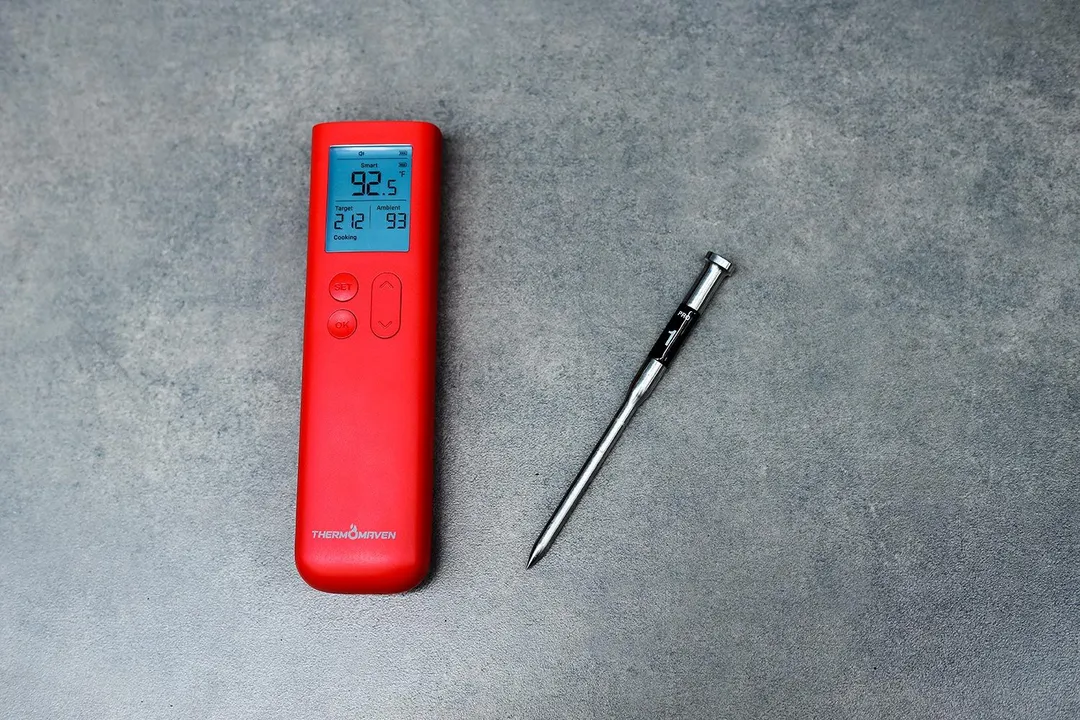
The G1 shares the P2's most important trait – full connection at every distance I tested, including upstairs and through multiple walls -- but comes in cheaper and with a few spec differences that won't matter to most cooks.
The probe is slightly different: 5.08 inches long and 0.22 inches in diameter (a touch thicker than the P2's 0.19-inch probe), with the same six-sensor setup and the same ±0.5°F internal accuracy rating.
In calibration, it read 32.1°F in ice water and 209.6°F at boiling -- a hair off the P2 but still well within spec. In the pork tracking test, it landed at 164.6°F against a 165°F target -- the second-best result in the group and more than close enough for any practical cooking scenario.
The big technical difference is connectivity: the G1 uses Sub-1G wireless technology instead of the P2's Bluetooth 5.3. Sub-1G operates at frequencies below 1 GHz, which gives it stronger wall-penetrating capability at the cost of a slightly different signal profile. In practice, both thermometers reached the same distances in my tests. Whether you'd notice a difference in a real home kitchen – with more interference, more obstacles – is harder to say.
Unlike the P2's smartphone-sized base, the G1's plastic base is slimmer and modeled quite like a TV remote. It runs on a slightly bigger 2,000 mAh battery, connects via Bluetooth, Wi-Fi (2.4 GHz only), and Sub-1G. The ambient temperature range goes up to 932°F – much higher than the P2's 752°F ceiling, making it more practical if you're cooking over open flame or in a very hot smoker.
The G1 comes with one probe rather than two – fine if you only ever cook one thing at a time. If not, the P2's two-probe package may be a better fit.
Both carry the same warranty structure. At $59, the G1 is a genuinely strong performer – the range results alone put it ahead of the other two thermometers in this test, and the accuracy numbers hold up well for the price.
ThermoMaven G1 – Best Budget
Price: $59
3. CHEF iQ Sense – Best for Guided Cooking ($129)
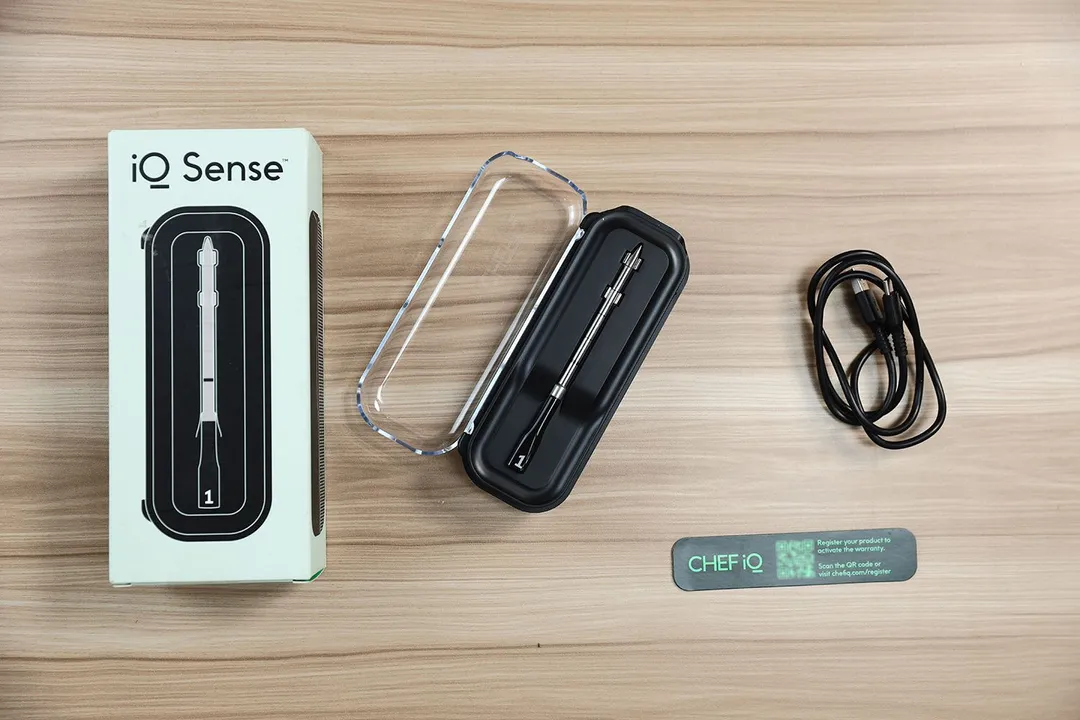
The CHEF iQ Sense is the thermometer I'd hand to someone who wants the cooking experience handled for them. The hardware is good, and the app experience is exceptional.
Range first: the Sense only connected cleanly in the kitchen – it lost signal outdoors and upstairs in my tests. That's a more significant limitation than I expected at this price, and worth factoring in if your setup involves cooking outside or across floors. For most apartment kitchens or single-floor homes where you're staying nearby, it won't come up – but it's a real gap compared to the ThermoMaven duo.
Accuracy told a different story. The Sense read 34°F in ice water – two degrees off the 32°F target, the widest miss of the five thermometers I tested. At boiling, it came in at 210°F, which is fine. In the pork tracking test, it landed at 168°F against a 165°F target – within the ±5°F window, but on the warmer side. Not a dealbreaker for most cooks, but the ThermoMaven probes were noticeably tighter.
The probe is stainless steel and ceramic with five sensors: four internal (range 32°F to 212°F) and one ambient (range 32°F to 1,000°F). That 1,000°F ambient ceiling is the highest of the five thermometers in this test and makes the Sense genuinely suited to open-flame grilling and high-heat searing where ambient temperatures can spike dramatically.
The hub charges the probe, relays temperature data to the app via Bluetooth and Wi-Fi, and includes a speaker for voice alerts (unfortunately, you can't play music or any kind of personal audio on it – a shame, because it does sound quite good). Bluetooth range is 200 feet in open air.
The app – and this is the Sense's strongest argument – is the best guided cooking experience I tested. Many different presets, video walkthroughs, step-by-step guidance that adjusts dynamically to how your cook is progressing. If you're newer to cooking and want something that holds your hand through the process, the Sense's app does that better than anything else here.
The warranty is two years from date of app activation – a reasonable backstop, and the strongest of the four thermometers in this roundup. One practical note: the probe should not be used for pressure cooking or microwaving, and its internal sensors max out at 212°F, so it can't double as a candy or deep-fry thermometer.
The CHEF iQ Sense sits in an honest middle ground: the best app experience here, a class-leading ambient ceiling, and a two-year warranty – offset by range that lags behind the ThermoMavens and middle-of-the-pack accuracy.
CHEF iQ Sense – Best for Guided Cooking
Price: $129
4. MEATER SE – Best for Beginners ($79)
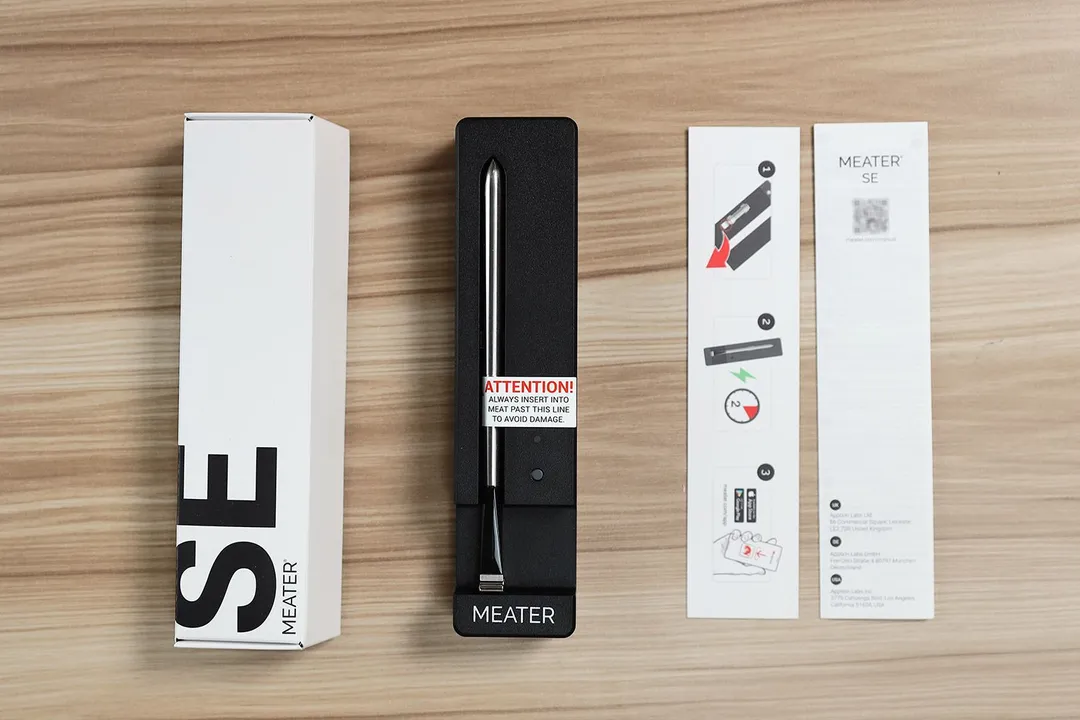
The MEATER SE is the easiest thermometer to recommend to someone who wants to try wireless monitoring for the first time. While not the most capable thermometer in this roundup – it lost signal outdoors and upstairs in my tests – for the kitchen and backyard use case it was designed for, it does the job cleanly.
Two sensors: one internal (up to 212°F), one ambient (up to 527°F). That ambient ceiling is the lowest of the five thermometers here, which rules it out for very high-heat open-flame cooking but covers most oven, grill, and smoker scenarios a home cook actually encounters. The range tops out at 165 feet via Bluetooth, with extended range available through MEATER Link WiFi and Cloud if your phone is on the same network as the charger.
Accuracy at the calibration checkpoints was solid -- 32°F in ice water and 210°F at boiling, both on the money. Where the MEATER SE showed its limits was the pork tracking test: it landed at 170°F against a 165°F target, brushing the outer margin of the ±5°F window. While still theoretically acceptable, it reflects a real-world risk -- leave it in too long while trusting the reading, and you've overcooked your meat.
The setup is simple: the probe charges in a compact plastic block that takes a single AAA battery – no USB-C cable, no hub. With less to go wrong, less to set up, and less to carry around, the minimalists among my readers will appreciate this. The probe itself is dishwasher safe, which no other thermometer in this test can claim.
The MEATER app is polished and has a guided cooking function similar to the CHEF iQ – 50-plus recipes, real-time notifications, cook time estimates that update as the cook progresses. It's not as comprehensive as the CHEF iQ app, but it covers the basics well.
At $79, the MEATER SE is a reasonable starting point for someone new to wireless thermometers who cooks primarily indoors or on a patio. Just keep the pork test result in mind – and consider pulling a few degrees earlier than the app suggests until you've got a feel for how it tracks.
MEATER SE – Best for Beginners
Price: $79
Overall Verdict
For most households, the ThermoMaven P2 is the one to get. The range performance is the best in this roundup – one of only two thermometers here that hit all four distances – and the two-probe package means you're not buying a second probe the moment you want to monitor ambient and internal temperature at the same time. It's expensive, but it's the kind of purchase you make once.
If the P2's price is hard to justify, the ThermoMaven G1 is the next best thing. Same range results, ~$90 cheaper, and a higher ambient temperature ceiling for high-heat cooking – the only real trade-off is dropping from two probes to one.
For guided cooking and a best-in-class app experience, the CHEF iQ Sense is the right pick – as long as you're not routinely cooking from a different floor. The two-year warranty also gives it the edge in long-term peace of mind.
And if you're new to wireless thermometers and not ready to spend north of $100, the MEATER SE can be a pretty compelling option. It’s simple and good enough for the majority of home cooking situations – even if it won't follow you upstairs.

Luna Regina
Writer, Author- C. Selectsgot the chef iq based on the guided cooking thing and yeah the app is genuinely good if your still learning. one thing you didnt mention tho - the voice alerts are pretty loud if that matters for your setup. fair warning if your cooking early morning or something. otherwise solid recomendations here
- Emmawish I'd read this before buying.