
Ever went to the kitchen to prep dinner and as you drag your knife across a tomato, instead of slicing cleanly through like it once did when you first bought it, the blade just ended up squishing the poor thing?
Then you try to desperately saw through the mushed-up vegetable.
The tomato soon loses its dignity.
And so do you.
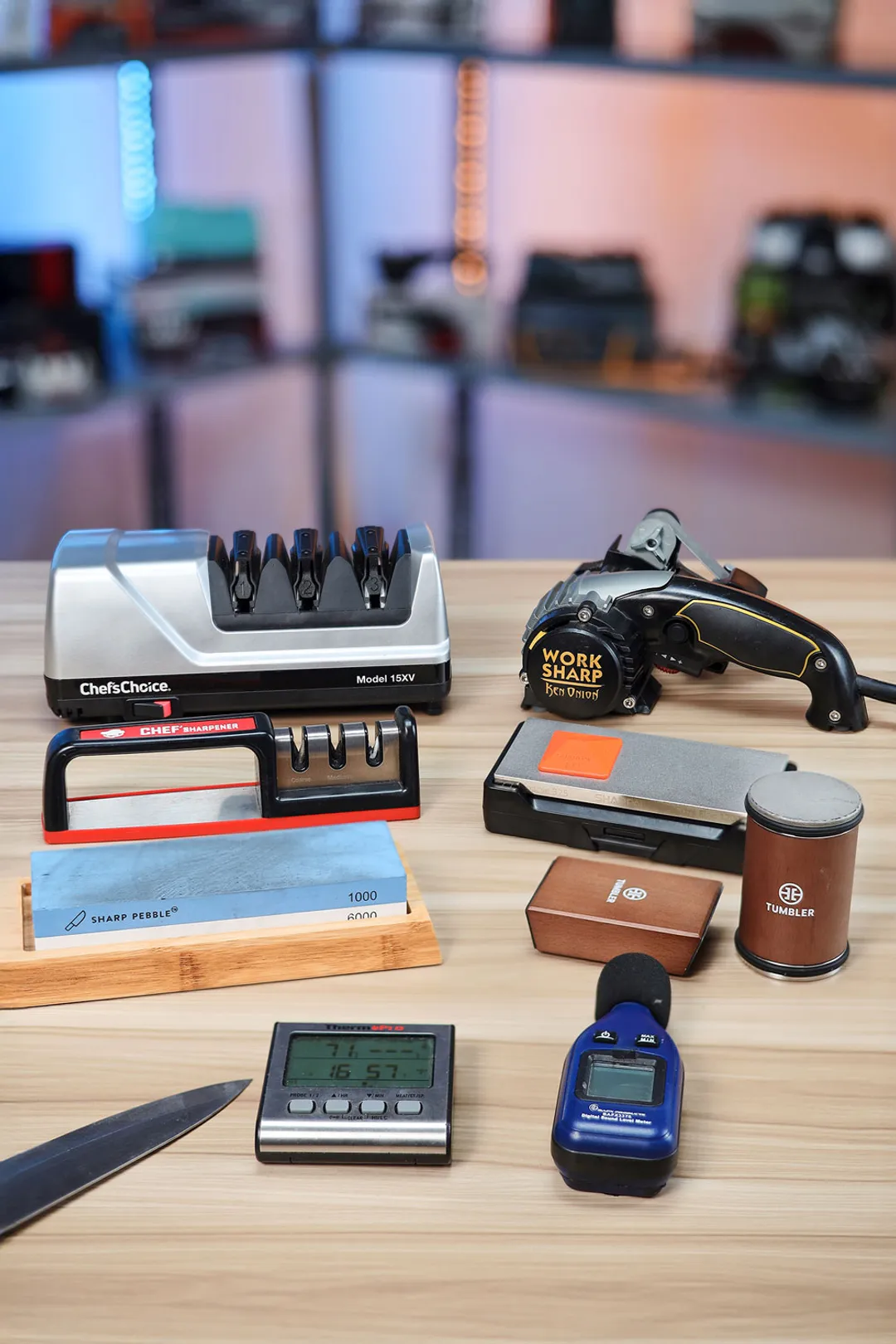
In my personal opinion, most people have dull knives not because they don't care or aren't annoyed by the blunted edge, but more because sharpening them can feel intimidating. There's a market full of devices ranging from $10 pull-through to $200 belt-based systems, each one with different settings and uses and "things to avoid". That's how I ended up buying – and putting through their paces – 27 knife sharpeners, manual and electric both, to find the five that are actually worth your money.
Here's How I Tested Them
Every knife started from the same place: I ran each one across sandpaper until it was uselessly dull, then confirmed that with a paper-slicing test.
From there, each sharpener was timed to see how long it took to reach two target sharpness levels – functional sharpness (clean lemon cut) and high sharpness (slicing beef tendon).
I also measured how much knife material each machine removed in the process to look for ones that can sharpen without shaving away too much.
Finally, I looked at the resulting edge under magnification for smoothness and consistency.
Noise levels and surface temperature were logged too – nobody wants to cause hearing damage just to prep dinner.
*All the prices in this article are at the point of publication.
**All test data are derived from our tests at ShouldIt.com.
1. Chef's Choice Trizor XV – Best to Buy
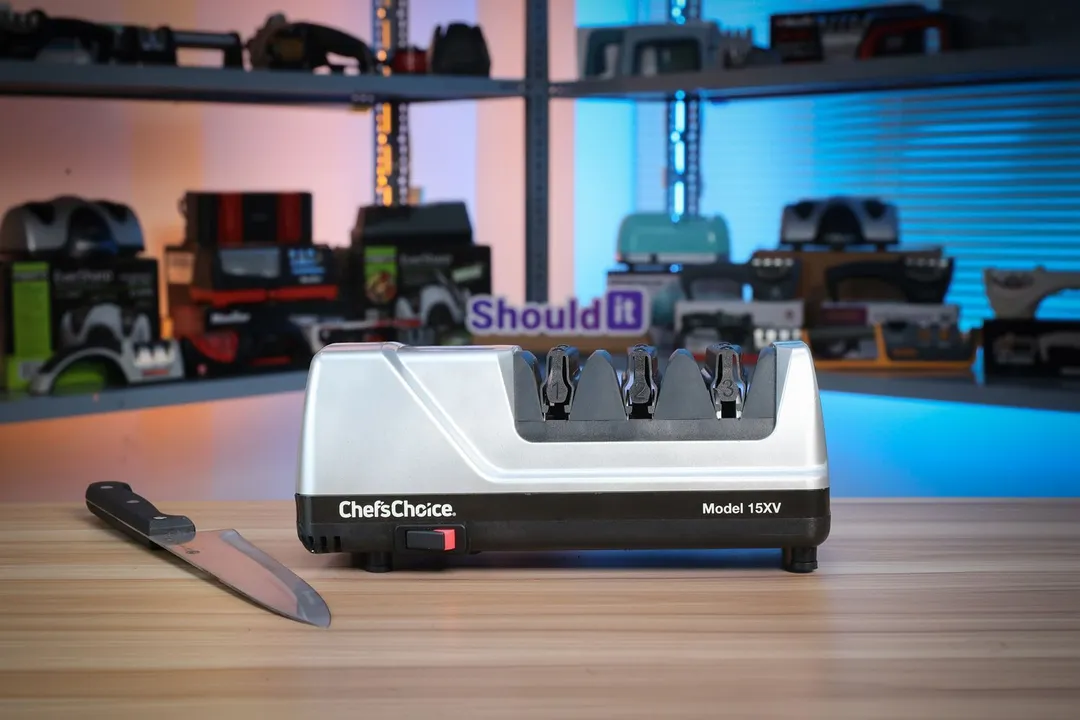
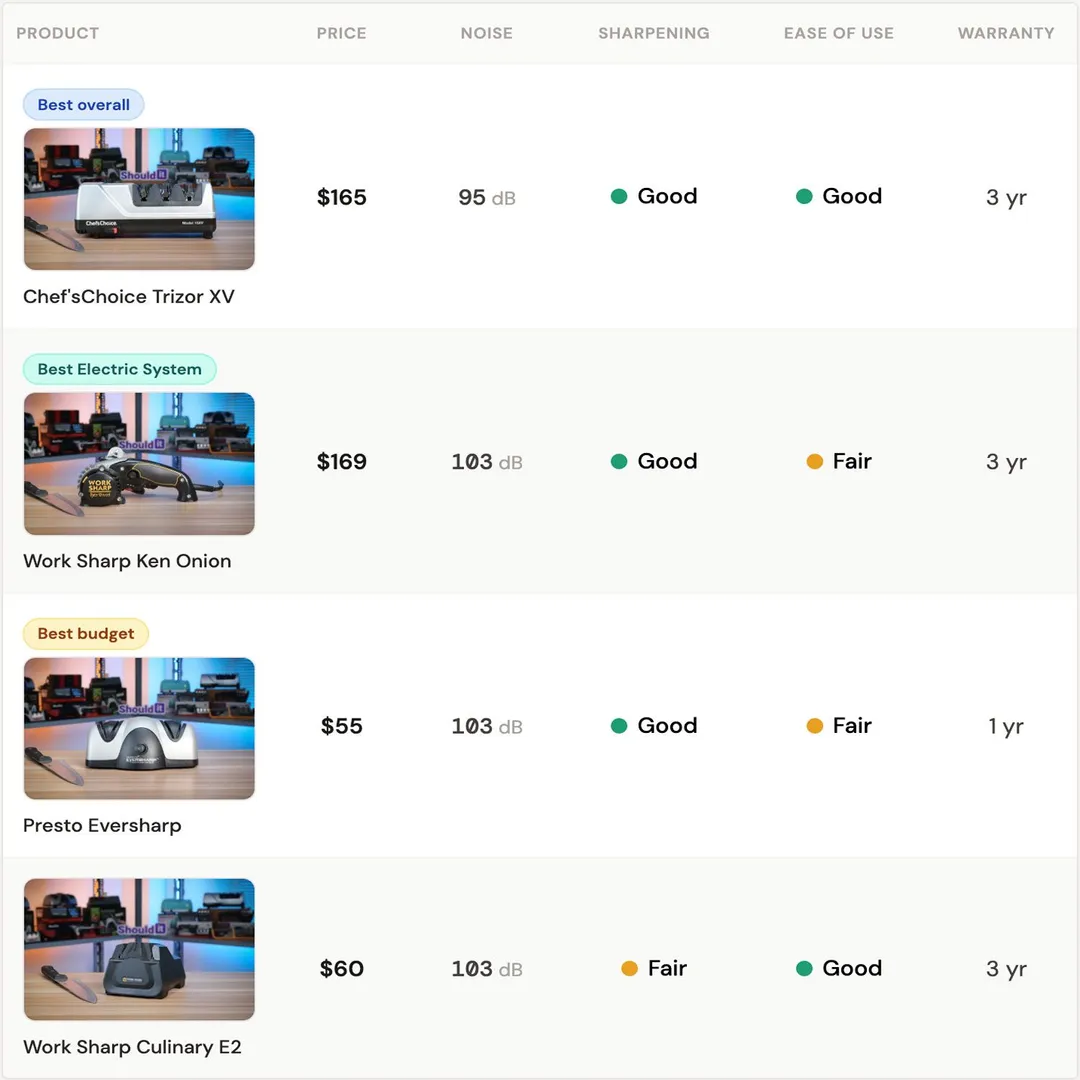
For everyday home cooking, the Chef's Choice Trizor XV is genuinely the most practical machine I've tested. At $165, it's – admittedly – not cheap, but the moment you unbox it you understand why it earns its reputation. Plug it in, press a button, and sharpen your knife – that's all you have to do to get a good blade with the Trizor XV.
What I like the most about this sharpener is the spring guide: they prevent you from applying too much pressure and damaging the blade. The guides automatically adjust, meaning you can't accidentally over-grind no matter how hard you press. Most other sharpeners don't have this.
In my speed test, the Trizor XV brought a sandpaper-destroyed test knife to beef tendon-cutting sharpness in 32 swipes and just under six minutes. On a normally dull knife – which is what you'll actually be sharpening – you're looking at two to three minutes. The edge is compound-beveled with bevel height nearly double what most machines produce, so it stays sharp longer between sharpenings.
Once sharpened, you can use the same blade for two to three months. After that, it only needs very light honing and polishing again using the second and third slot on the sharpener.
The build is quite impressive. It's a bit bulky, sure, but the quality is excellent: parts fit tightly together, and the unit has a very sleek finish. After extended testing, it still looks and works like new. The sharpening discs are remarkably durable, as well. I ran the machine for 20+ minutes straight without overheating, and the continuous operation capability means you can sharpen your entire knife collection in one sitting without the machine complaining.
The sharpening angle is fixed at 15 degrees – the sweet spot for Western-Japanese hybrid knives. It's not ideal if you have traditional 20-degree German blades or full-bolster knives, but 15 degrees should be alright for the majority of kitchen knives. The third-stage stropping discs also handle serrated knives beautifully, straightening and honing bread knives and sliced beef knife edges without destroying the teeth.
The tradeoff for that wider, stronger bevel that keeps its edge longer is more material removal. So you sharpen less often, but each session takes a bite out of the blade. Not a dealbreaker unless you own expensive, thin Japanese knives – which will fare better with a rolling or a whetstone-like sharpener.
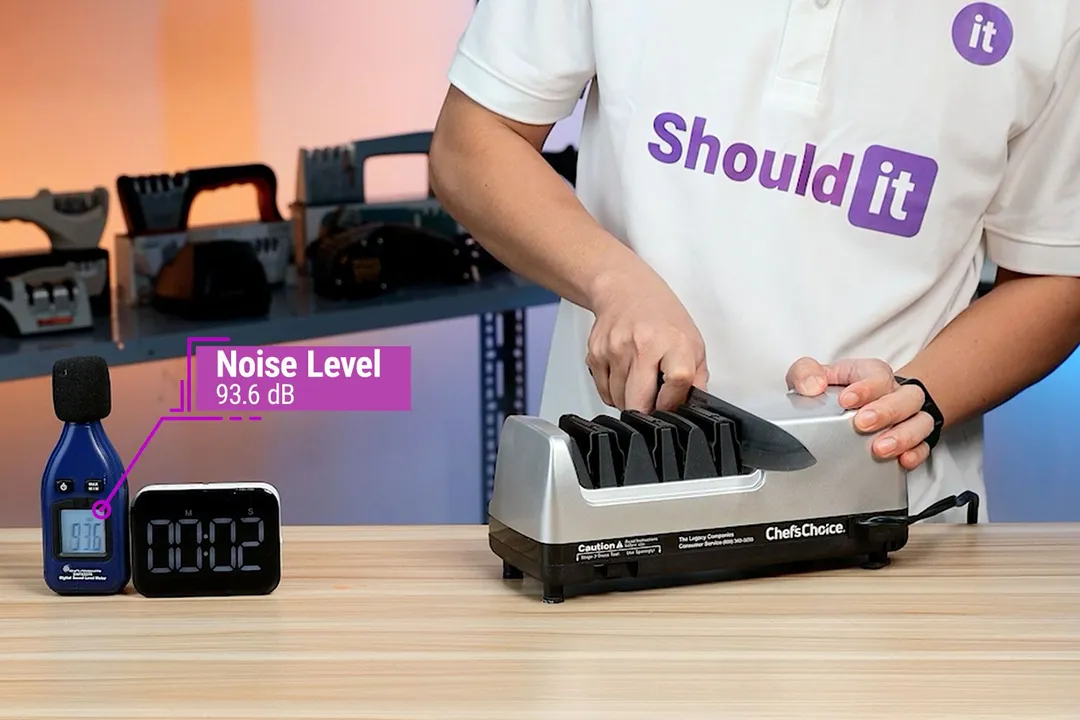
Noise peaks at 95.2 dB in the coarser stages, but it runs cool (stays under 100°F through extended use) and contains metal dust well. Cleanup is literally just wiping it down. The 3-year warranty is one of the strongest in this category.
For most home cooks – the people who just want sharp knives without complication or learning curves – this is the one. I’ll say, without any reservation, that it’s the most comfortable, most convenient, and most forgiving sharpener in its class – with only the Work Sharp Ken Onion even coming close to its overall scores. It didn’t make the best-to-buy position only because it’s a bit fussy to set up. However, if that’s not an issue for you, the next sharpener on this list can be just as good an option.
Chef's Choice Trizor XV – Best to Buy
Price: $165
2. Work Sharp Ken Onion – Best Electric System
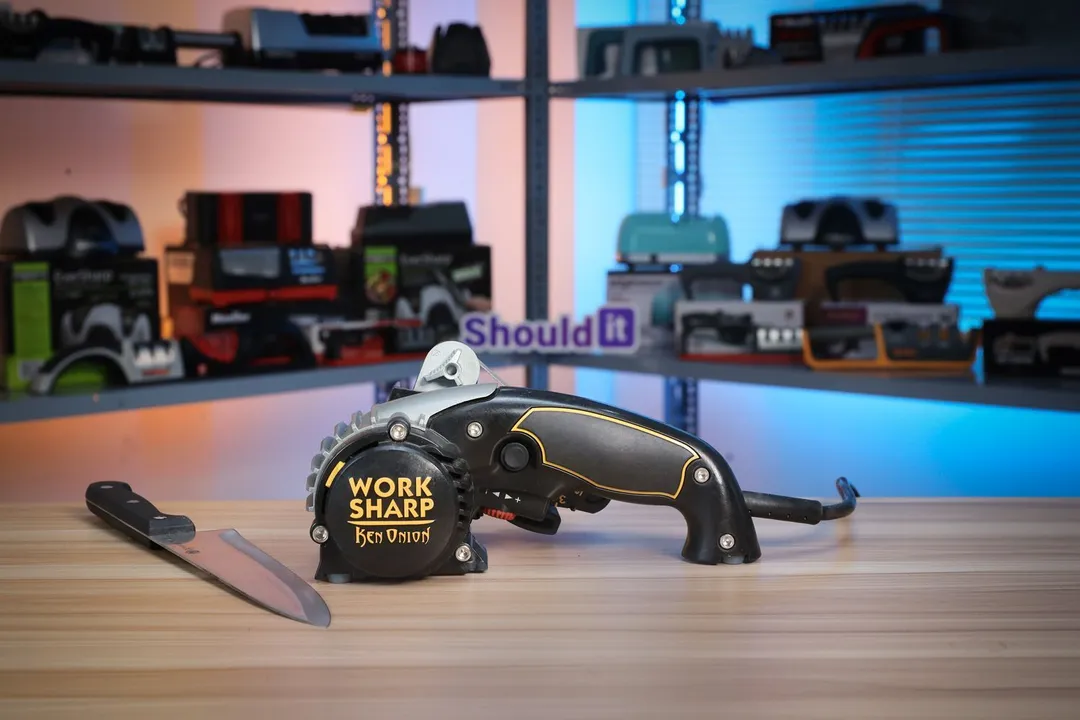
Update: Work Sharp has released the Ken Onion Mk2, an upgraded version of this sharpener. All features covered in this review carry forward to the new model, and we'll have a full review of the Mk2 coming soon.
The Work Sharp Ken Onion looks more like a garage power tool than something you'd find in a kitchen – which... comes to think of it, is basically what it is. At around $169.95, this belt-based electric sharpener produced one of the wickiest sharp edges I've seen.
After running a dulled blade through, the Work Sharp Ken Onion was able to polish it to a mirror-like sheen. It achieved Level 9 sharpness (beef tendon) in just over four and a half minutes, making it the fastest machine in this group. The convex edge the belts produce is stronger than a traditional flat-ground edge, and the adjustable angle guide – 15 to 30 degrees at one-degree increments – means you can match it to virtually any knife in your collection. Japanese blades at 15, German knives at 20, and anything in between. No other electric sharpener at this price comes close on that front.
There is, however, a caveat: the Work Sharp Ken Onion is genuinely not a family kitchen-appropriate appliance.
This is not a joke.
At 103.8 dB, it can cause hearing damage after about 15 minutes of continuous exposure. The belts also throw fine metal dust in every direction, which rules out using it anywhere near food prep areas. The user guide itself requires safety glasses, a dust mask, and ear protection. It's better to store and use it in a garage or outdoors than at your kitchen counter.
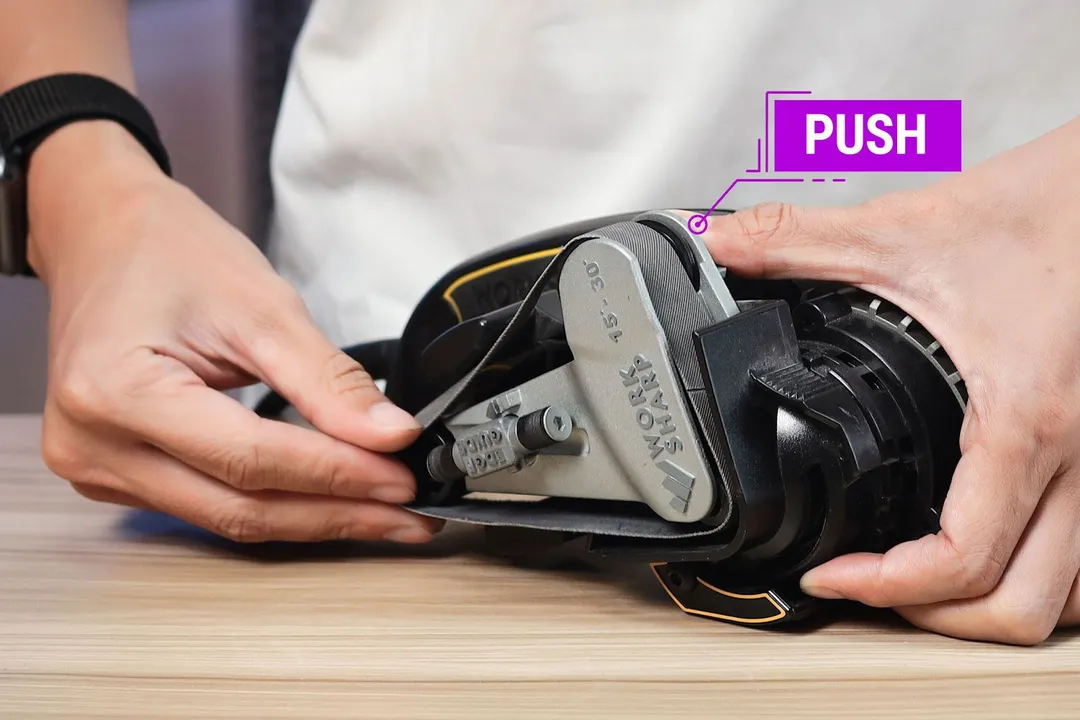
There's a steep learning curve to it, too. Setting up the angle guide, installing the belts, adjusting speed, and maintaining a consistent stroke all take a few sessions to get comfortable with, especially if this is your first motorized knife sharpener. The first few blades I sharpened on this thing probably didn't come out perfectly. The good news is that once you know what part goes where, Work Sharp makes it relatively easy to do everything – changing out the belt in particular is quite an intuitive process on the Ken Onion.
Material removal is on the higher end – comparable to the Chef's Choice – so it's not the gentlest on valuable blades. The warranty is three years, which is quite long, so rest assured when you buy.
For someone who wants the absolute best edge their knives can achieve, works on all kinds of blades including outdoor tools and scissors, and doesn't mind the setup and safety requirements, the Ken Onion is the clear choice. For everyone else, it's probably more machine than the situation calls for.
Work Sharp Ken Onion MK.2 – Best Electric System
Price: $169
3. Cubikook CS-T01 – Best Manual
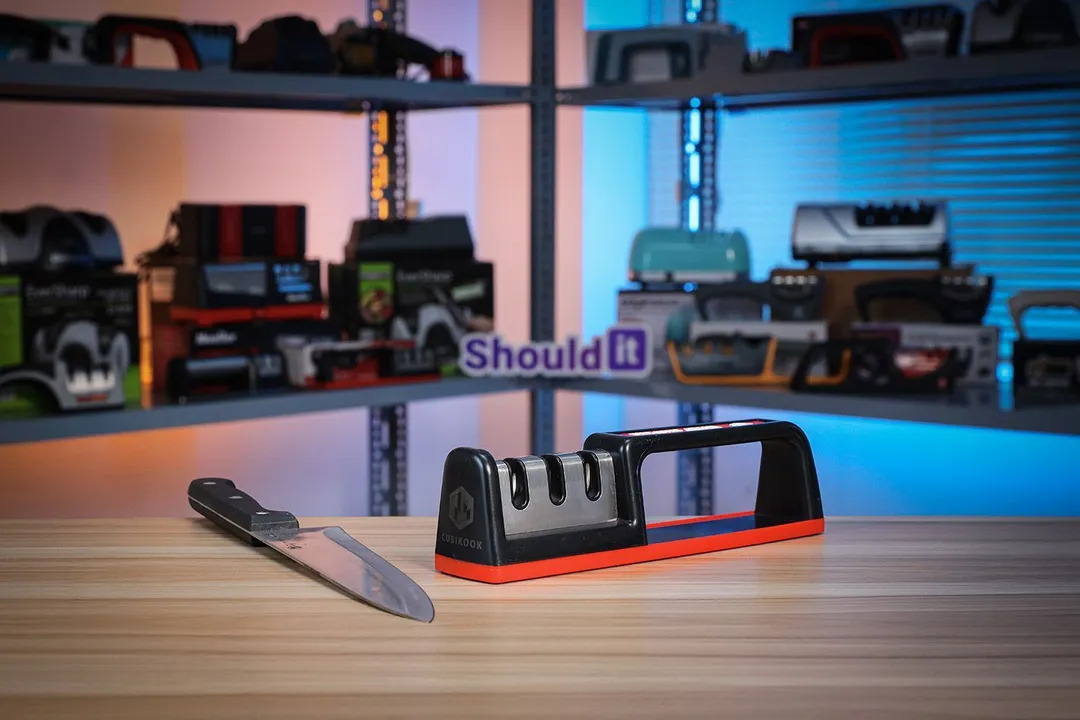
I’ve tested over a dozen different manual sharpeners, and when I got to the Cubikook CS-T01, I wasn't impressed. It's $15, plastic, and looks like something you'd impulse-buy near a checkout counter. But boy, I'm sure glad I didn't skip it now.
This is, without question, one of the best manual knife sharpeners I've tested. The stability alone sets it apart. The working section sits low and screws directly into a wide, flat base, which keeps the center of gravity so low that it essentially doesn't move during use. Even with deliberate sideways pressure, it didn't wobble. For a pull-through sharpener, that's quite unusual since, in my experience, most of them tip over if you even so much as sneeze near them.
In my speed test, it brought my dull test knife to functional sharpness – clean lemon cut – in 90 seconds. For most knives in normal everyday condition, you'll see a clear improvement in under 30 seconds. The maximum sharpness it achieved was Level 8 on my scale, which is chicken-breast-with-skin territory. It didn't crack Level 9 (beef tendon), which is the ceiling for electric machines. That's an honest limitation and the main reason it sits in the manual category rather than competing for the overall position with the Chef's Choice Trizor XV.
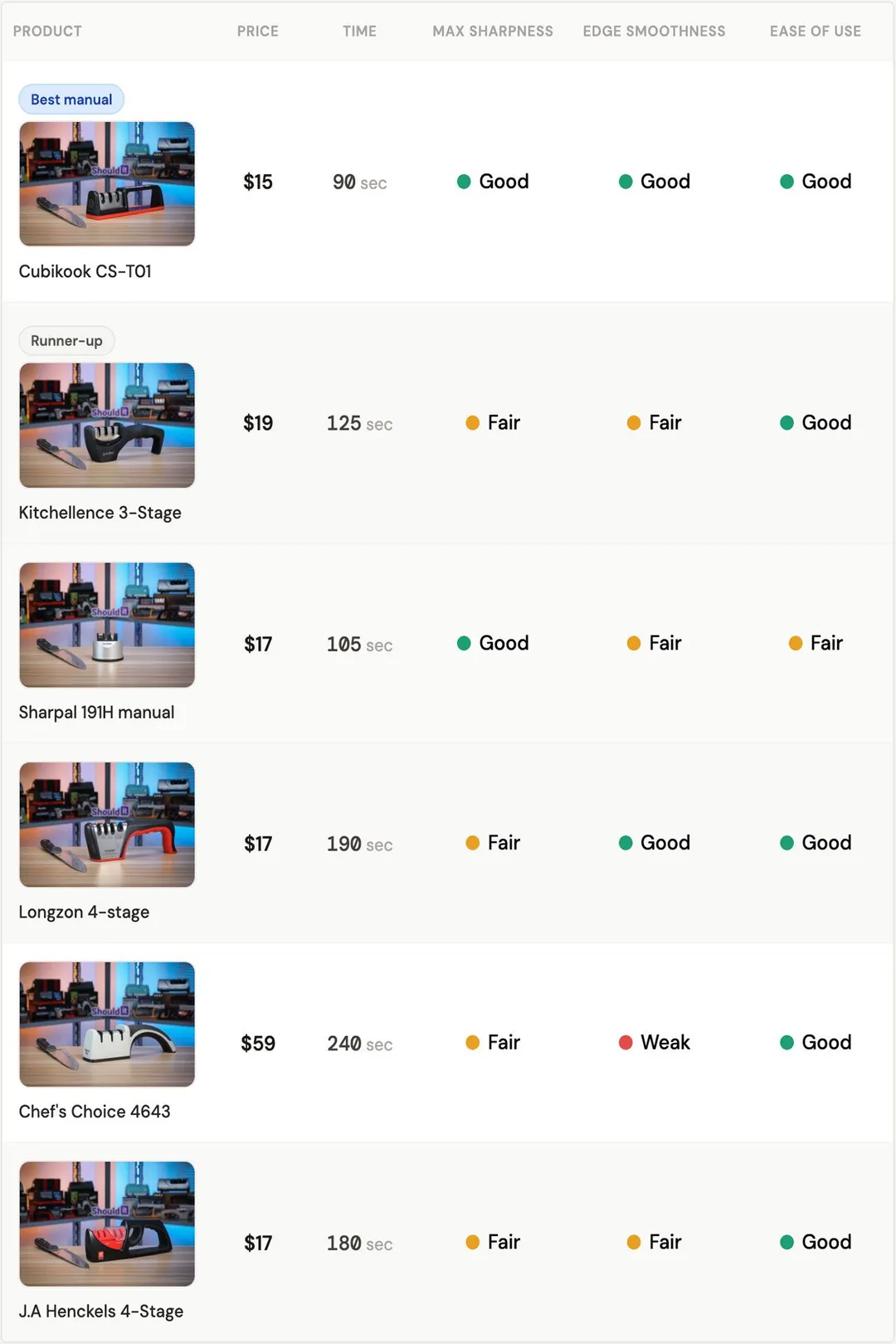
Where it stood out most was edge smoothness – the best result of any device I tested, electric or manual. The three-stage system (diamond rods, then tungsten carbide, then ceramic honing) works in a logical progression that removes material carefully and leaves a consistent, clean edge. Other manual sharpeners tend to chip the edge in the coarse stage – the Cubikook manages this significantly better because the diamond rod stage straightens the edge before the tungsten stage touches it.
The only issues I noted in extended use: the small ceramic rods in the third stage can come loose after heavy use – both units I tested developed this over time. It doesn't seem to affect the final edge much, but it's something to know. The grip is also thin and plain, which is functional if not particularly comfortable.
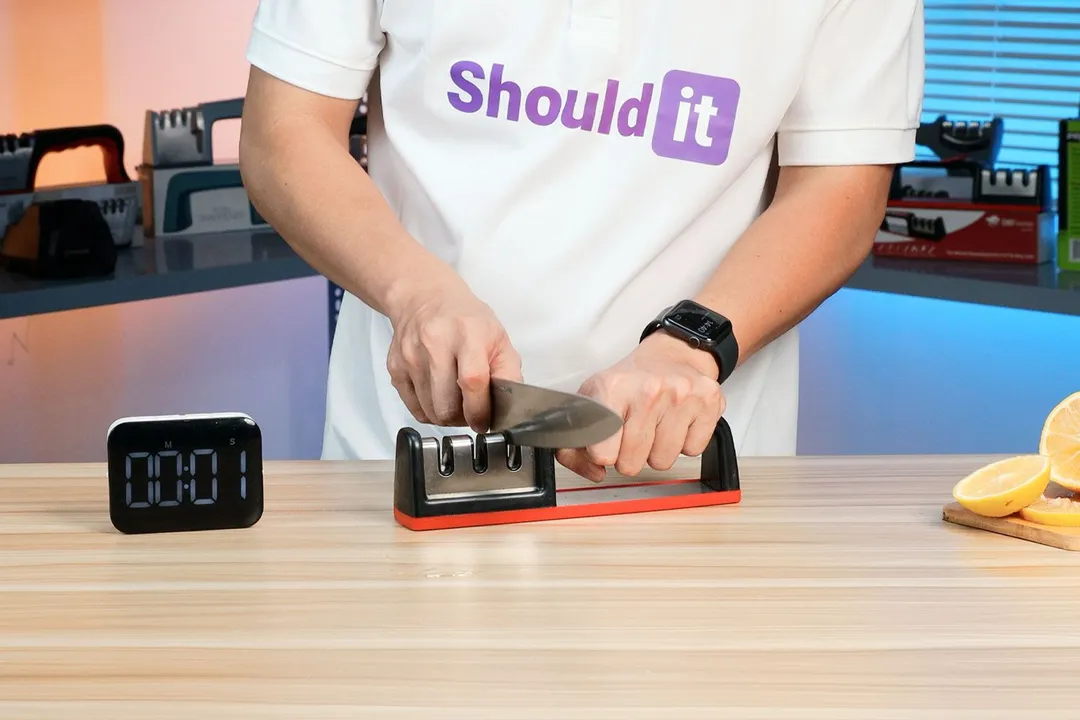
No noise, no heat, no dust. The Cubikook is as beginner-friendly as any sharpener gets. At $15 with a build quality that's held up through my testing without complaint, it's an almost unfair value. If you're not ready to spend $165 on a Trizor XV or simply prefer a manual option, this is the one to get.
Cubikook CS-T01 – Best Manual
Price: $15
4. Tumbler Rolling – Best for Precision Without Learning
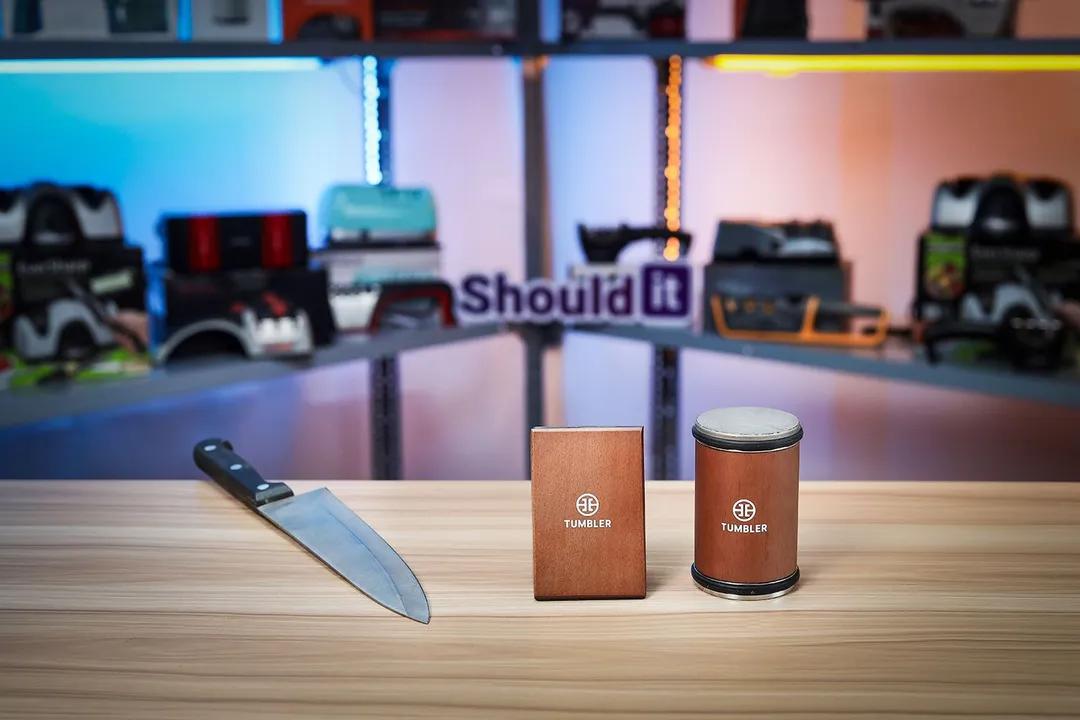
The Tumbler rolling knife sharpener sits somewhere between the simplicity of a pull-through and the control of a stone. At $129, it's not cheap, but with it, you can get two of the biggest barriers to manual sharpening out of the way: getting the angle right and the 15-minute soak.
Rolling sharpeners are probably the most intuitive innovation in kitchen knife sharpening since… well, since electric sharpeners. It’s far simpler than a manual whetstone once you’ve gotten a hold of the technique.
Of the three sharpeners I bought (the other two being the HORL 3 and the AIERLIAN), the Tumbler stood out the most for its usability. Sharpening performance is roughly the same across, but the Tumbler has a nice weight in the hand and rolls a bit more smoothly (which helps with fatigue over long sharpening sessions) – that’s how it made the list.
There are two parts to the Tumbler: first is a magnetized angle guide, then the roller itself. You snap the blade of your knife to the angle guide, which fixes the blade at either 15 or 20 degrees. Once secured, you take the sharpening cylinder and slide it along the edge of the blade. The fixed angle means your knife "learns" the angle on the first pass, which can take a few extra minutes, but after that – faster and more consistent than a whetstone ever would be without years of practice.
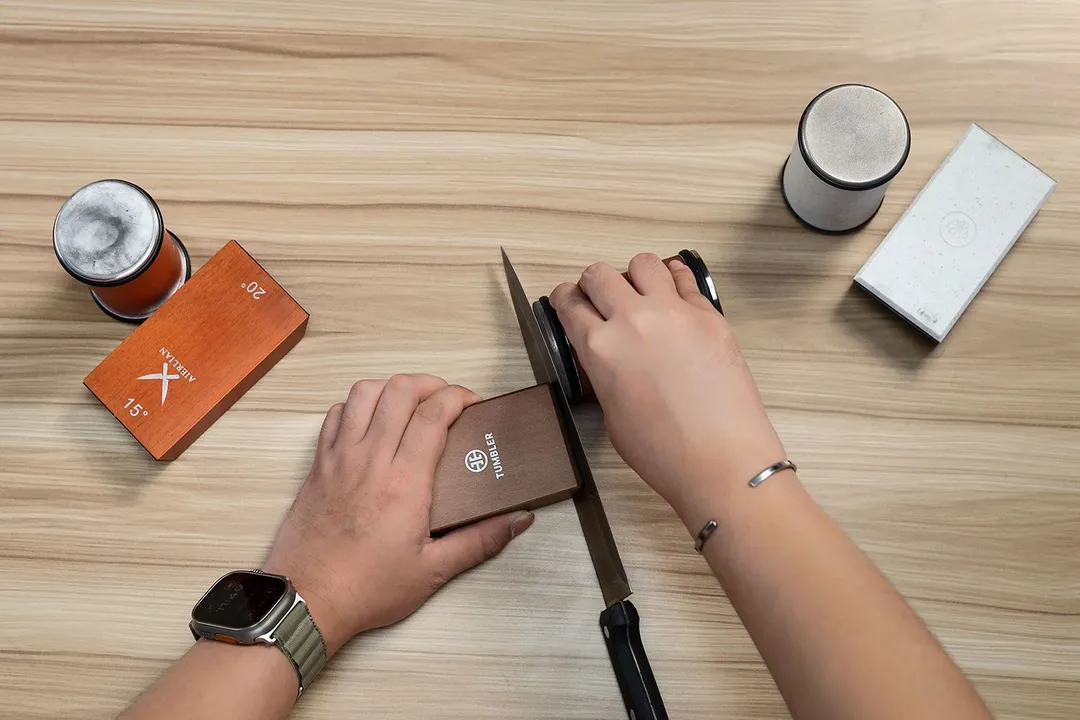
I sharpened a dull chef's knife to a crisp, paper-slicing edge in around six minutes on my first try – if you don’t have a lot of whetstone experience, it may take up to 10 minutes or more. I found no uneven bevels, no high spots on the European-style knife I used for the test.
The roller is heavy in the hand and rolls very smoothly across my countertop without any perceivable friction. One side has the diamond disc, which is aggressive and sharpens the blade very quickly (there’s a lot of metal shavings after). The other side holds the stainless steel honing disc – it cleans up the edge and removes grinding dust nicely without much more metal being removed.
There are several limitations, however. The first thing I noticed while trying out these rolling knife sharpeners is that, if you have a lot of blades you’d like to hone, the hand you use to work the roller can become fatigued after a while. In my case, I tried to compensate by curling up my fingers, which would put them directly over the rolling knife edge. It’s not an inherent design issue with the sharpener, but it’s one thing to take into consideration if you’re going to pick a rolling sharpener.
Additionally, if you intend to use the sharpener for smaller knives – such as folding or paring knives, it can be really difficult to fit the blade on the angle guide. This seems to be made solely for sharpening the kitchen and other long-bladed knives over 6 inches in length.
It's a premium tool that swaps the tactile craft of whetstone sharpening for speed and consistency – ideal if you own delicate or expensive blades that need exact angles and careful technique. If that trade-off appeals to you, it's one of the best sharpeners I've tested. But if you want a hands-on experience where you control the angle by feel, the SHARPAL 162N we’re going to take a look at next is going to be a better pick.
Tumbler Rolling – Best for Precision Without Learning
Price: $129
5. Sharpal 162N – Best Budget Whetstone
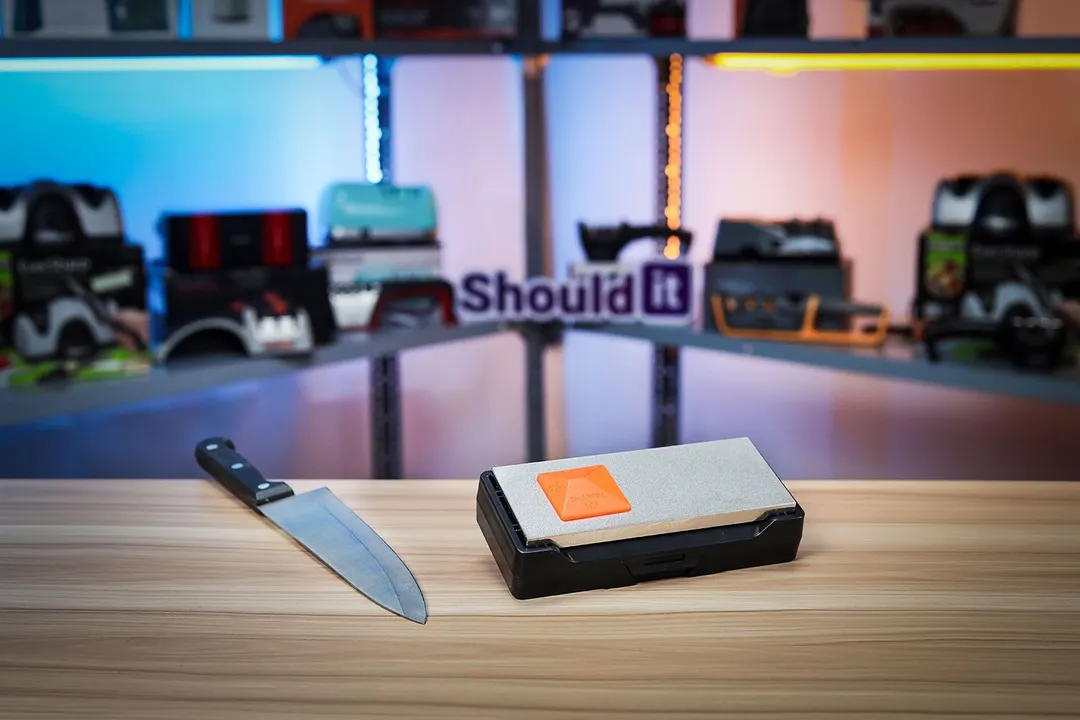
At $69.99, the Sharpal 162N sits in the mid-range but delivers more edge than you'd expect for the price. It's also the one that demands the most technique from you – but unlike the other two traditional water stone-type sharpeners I tested, you don't need patience for soaking or maintenance headaches with this one.
The package is heavy: you get a plastic case with a magnetized blade guide inside, then a slab of etched stainless steel coated with a diamond whetstone material (industrial-grade monocrystalline diamond, per Sharpal) on either side. The coarse side is 325-grit for shaping, and the finer, 1200-grit side is for honing and finishing. Both sides will outlast multiple sets of knives and require zero maintenance beyond a quick rinse. It needs no oiling or water to use – you can absolutely dry-sharpen with it.
The angle guide snaps onto the stainless steel stone. You use it by pressing the blade against it, which will angle your knife to one of the four preset angles (14°, 17°, 20°, 25°). It can take out some of the guesswork and keeping you from drifting into bad angles mid-stroke. But since the angle isn’t firmly fixed like with the Tumbler, you’re still responsible for the technique.
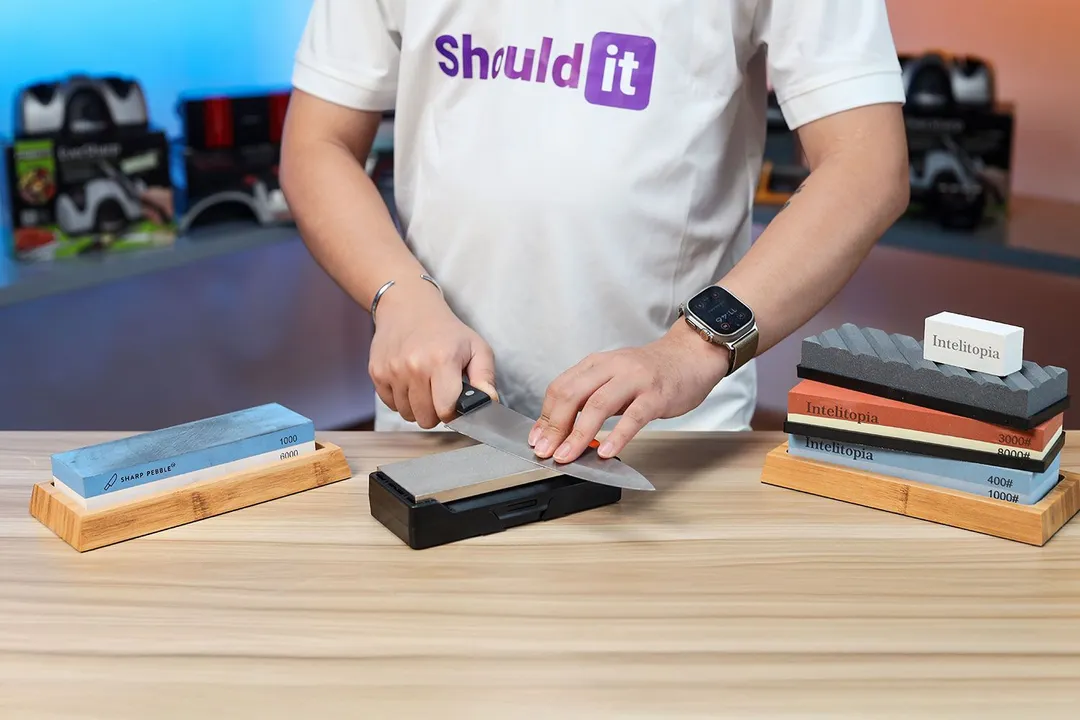
Sharpening speed depends on your blade condition and comfort level. It took me 5-7 minutes to go from a dull edge to a paper-cutting sharpness. The steel base and aggressive diamond don't remove as much material as the Tumbler or Ken Onion, which means your expensive blades stay intact longer.
The only issue, really, is that the 325/1200 grit jump is a bit steep between coarse and fine – some users would prefer a middle step – but it works fine for most kitchen tasks.
If you're willing to learn proper technique, want a tool that genuinely lasts, and can justify mid-range spending on a sharpener, I find the SHARPAL to be a solid investment.
Sharpal 162N – Best Budget Whetstone
Price: $69.99
Overall Verdict
So here's what I'd actually buy.
The Chef's Choice Trizor XV wins out for everyday kitchen use. It's straightforward, dependable, and gets the job done in minutes without needing you to fuss over things like belt changes. The three-year coverage is a nice safety net too.
Looking to spend less while still getting a solid sharpener? The Cubikook CS-T01 punches way above its $15 price. You won't hit the maximum sharpness level of electric machines, but you'll have sharp knives for the cooking you actually do every day.
If you own a collection of good knives you’d like to keep intact and in shape, the Tumbler Rolling Knife Sharpener will hit the sweet spot – it handles expensive blades gently, takes the guesswork out of angles, and still delivers clean edges without technique-heavy learning.
For the sharpest possible edge money can buy, the Work Sharp Ken Onion is a no-brainer – just accept that you're buying a tool for a garage or outdoor workspace, not your kitchen counter. There’s a learning curve to it, but once you’ve gotten it down, you won’t get a sharper blade with anything else.
And if you’d like to invest some time and learn the craft of manual knife sharpening, the Sharpal 162N is the most durable option here and costs less than half the Tumbler. It demands technique and patience, but it'll easily last thousands of blades before wearing out.
Pick the one that matches how you actually cook and what you're willing to tolerate. Any of these five will give you noticeably better kitchen performance almost immediately.

Luna Regina
Writer, Author- Mark GouldFinally got around to sharpening my knives after putting it off for way too long. Went with the Cubikook since it was only $15. Took like a minute to sharpen. Didn't expect a cheap plastic sharpener to actually work this well.
- Oliver StrattonPicked up the Trizor XV after seeing it recommended and super worth it